Somewhere along the way, we all absorbed the same unwritten rule: every metal in a room must match. Same finish on the handles, switches, taps, and hinges. It’s safe, tidy, and, if we are honest, a little forgettable.
Designers know better. Mixing metal finishes is not a mistake to be corrected; it is a deliberate technique, one of the subtle moves that separates rooms that feel considered from those that simply feel furnished. When done with intention, combining brass, black, pewter, and nickel adds depth, warmth and personality that a single uniform finish rarely achieves on its own.
This guide shows you how to mix metals with confidence, using brass as the warm anchor and black, pewter or nickel as supporting finishes.
Why does matching everything fall flat?
There is nothing wrong with a matched scheme. It is safe, coordinated, and entirely fine. But fine, as it happens, is rarely what anyone is aiming for.
The trouble with a single uniform finish is that it can come across as flat. Everything sits on the same visual plane, nothing draws the eye, and the room ends up feeling a touch showroom-generic. It looks correct but unremarkable; you get coordination, but you miss character.
Contrast is what brings a scheme to life. When you introduce a second or third metal, you create moments of light and shadow, warmth and cool, softness and edge. The eye has something to travel between.
A brass handle reads as richer next to a black switch plate. Pewter feels more deliberate beside the glow of brass. This is the real appeal of mixing metal finishes at home: not variety for its own sake, but depth that a matched scheme cannot quite reach.
The keyword is intention. A mixed scheme that happens by accident looks like an accident. A mixed scheme that follows a few simple rules looks like the elegant work of someone who knows exactly what they are doing.
The designer's rule of thumb: anchor, then accent
Here is the technique that makes it all work. Choose one dominant metal, then layer in one or two accents. That is the whole principle; everything else is detail.
Your dominant finish is the one that carries the room. It appears most often and sets the overall tone. Brass is the natural choice here, and not only because it is what we do. It is warm, versatile, and forgiving.
Depending on the finish, it can feel polished, aged, understated, or richly characterful. It flatters period properties and contemporary spaces alike; it brings light into darker rooms; and, in unlacquered finishes, brass can develop a richer character over time. Most usefully of all, it plays beautifully with other finishes rather than competing with them: a generous anchor.
A helpful way to think about proportion is the 60/30/10 principle borrowed from interior design. Roughly 60 per cent of your metalwork sits in the dominant finish, around 30 per cent in a secondary finish, and the final 10 per cent in an accent. You do not need a tape measure; it simply means one metal should clearly lead, a second should support it, and a third, if you use one at all, should appear only in small, intentional touches.
In practice, that might look like brass across your handles and switch plates, a black finish on a few statement fittings, and a whisper of pewter or nickel in the accessories. The brass leads, the black grounds, the pewter refines. Get the hierarchy right, and the room feels layered rather than busy. Ignore it, and you end up with three metals arguing for attention and none of them winning.
Brass and black: the confident pairing
If you are new to mixing metals, this is the combination to start with. Combining brass and black hardware is bold, graphic, and remarkably easy to live with.
The appeal lies in contrast. Brass brings warmth, glow, and a sense of craft. Black brings definition, weight, and a clean architectural edge. Put them together, and each makes the other look better. The brass feels warmer against the black, and the black feels sharper against the brass. It is a pairing that works as happily in a heritage home as it does in a pared-back modern one, which is rare.
Where should it go? Think about the moments your eye and your hand return to most often. Switches, sockets and knockers are often the best place to start because they are visible, tactile, and surprisingly easy to forget. A matte black switch plate can ground a room and provide architectural contrast, while a brass handle or knocker nearby adds warmth and lift.
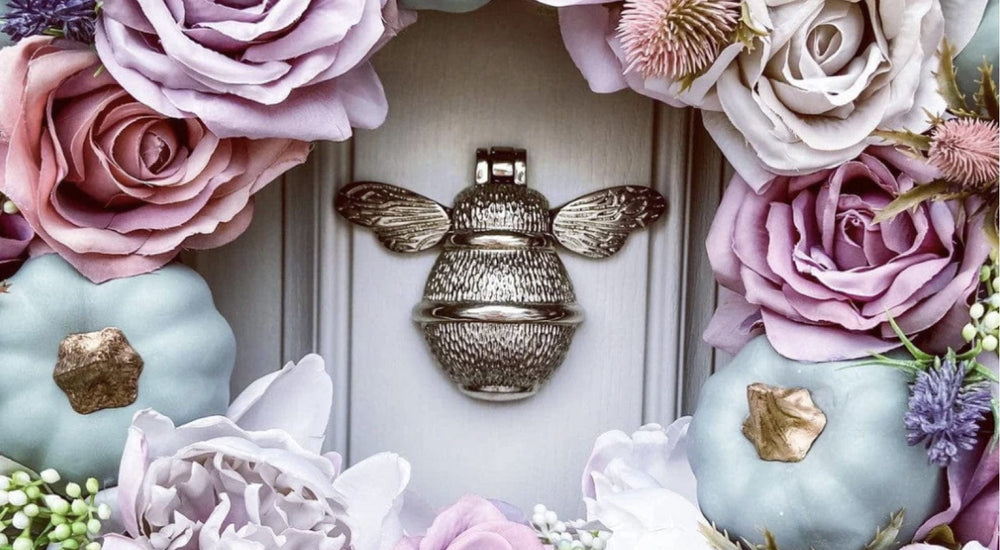
Taps and cabinet hardware are natural candidates, too. A Brass Bee door knocker against a dark-painted front door is a study in this exact pairing, made to be noticed before anyone has stepped inside.
As a rule, let black do the grounding and brass do the lifting. Use black on the larger or more architectural elements, the ones that anchor a space, and let brass provide the highlights that catch the light. Keep that logic consistent, and the pairing reads as entirely deliberate, which, of course, it is.
Brass with pewter and nickel: the quieter contrast
If brass and black is the confident handshake, brass with pewter or nickel is the quiet conversation across the room. This is metal pairing at its most understated, and it rewards a careful eye.
Pewter and nickel finishes bring a cooler, softer counterpoint to brass. Where black delivers hard contrast, these finishes offer tonal contrast: a gentle shift in temperature rather than a dramatic one. Pewter has a matte, slightly aged quality that feels grounded and calm.
Nickel is cleaner and cooler, with a subtle sheen. Choose a pewter finish for a muted, heritage-led scheme, and a nickel finish for a lighter, more modern contrast that still feels softer than chrome. Set against the warmth of brass, both create a layered, sophisticated effect that never shouts.
The one thing to watch is temperature: brass is a warm metal, while pewter and nickel are cool. That contrast is the whole point, but it needs a little care to stop it tipping into a clash. The trick is to let brass remain the clear hero and use the cooler finish as a carefully-chosen accent rather than an equal partner. A brass-led scheme with pewter finish detailing feels intentional; a fifty-fifty split of warm and cool can feel undecided, verging on chaotic.
These pairings suit detail-led homes and the people who notice the small things. They are ideal for bedrooms, studies, and quieter spaces where restraint does more work than drama. Layer them thoughtfully, and you get a home that feels collected over time rather than bought in one go.
How to keep a mixed scheme cohesive
Freedom needs a framework; a few simple rules keep a mixed scheme from feeling chaotic.
-
Repeat each metal at least twice. A finish that appears only once looks like an accident. Repeat it, even in small ways, and it reads as a choice. Think of at least 2 touchpoints for every metal in the room.
-
Keep finishes consistent within a function. This is the one most people miss. All your switches and sockets should share a single finish, even if the rest of the room mixes freely. Consistency within a category creates order underneath the contrast.
-
Let brass lead throughout the home. A common anchor carried from room to room is what turns a series of separate decisions into one coherent design. The front door speaks to the hallway, the hallway to the living room, and so on.
-
Use hardware suites to tie it together. Cohesion is far easier when your pieces are made to sit together in the first place. Many of our pieces are designed to sit together, so knockers, handles, switch plates, and finishing touches can share a common design language from the outset. Mixing metals well is much simpler when the foundation is already considered.
For example, use brass for every switch and socket, black for internal door handles, and nickel for hooks or bathroom details. That gives each metal a role, rather than scattering finishes at random.
Ready to mix with confidence
Mixing metals was never really about the metals. It is about confidence and intention, the willingness to move past the matched-everything default and build something with genuine depth. Choose your anchor, usually brass, layer your accents with care, keep each finish consistent within its function, and repeat every metal enough times to make it feel deliberate.
If you prefer warmth over the contrast of pewter or nickel finishes, consider working in touches of antique copper as a softer third finish. Its aged, burnished tone sits close enough to brass to feel harmonious, yet distinct enough to add richness and depth.
Do all that, and mixing metal finishes at home stops feeling like a risk and becomes the natural choice for a home with real character.
Explore the collection and see how our brass hardware, switches, sockets, and finishing touches are designed to work beautifully together, and with the metals already in your home.